
Cross-Boundary Business Operations

Cross-boundary business operations may encounter corruption risks due to the differences in law, social environment, staff culture as well as problems relating to "remote management" of the business.
A case in point
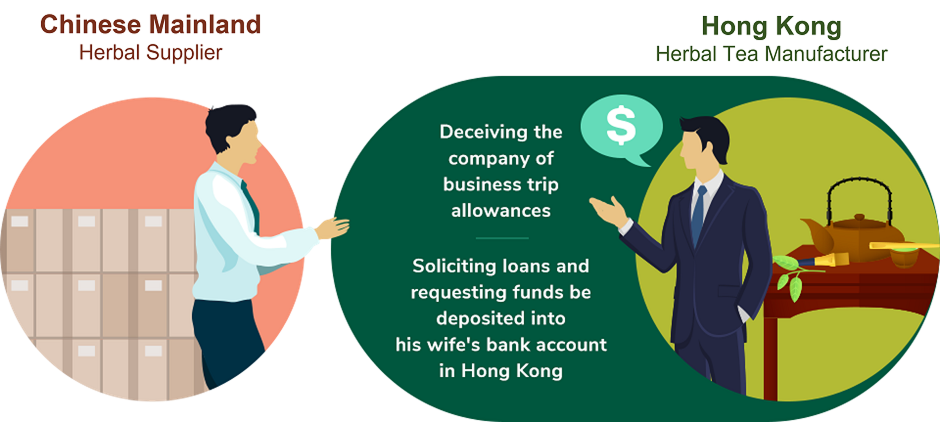
- A senior merchandiser of a Hong Kong-based herbal tea manufacturing company is responsible for purchasing herbal materials from various Mainland suppliers.
- On several occasions, the senior merchandiser solicits loans from a Mainland herbal supplier in return for placing purchase orders with the latter.
- He also inflates the expenses incurred in his business trips and furnishes false receipts to deceive the company.
Yes. The senior merchandiser has committed offences under Section 9 of the POBO which deals with corruption crimes in private sector.
He has violated Section 9(1) of the POBO because he is an agent (i.e. an employee), who without the approval from his principal (i.e. the herbal tea manufacturing company), solicits an advantage (i.e. loans) from a supplier as an inducement for his doing an act in relation to his principal’s business (i.e. placing purchase orders with the supplier).
He might also violate Section 9(3) of the POBO by using false documents (i.e. furnishing false receipts with inflated expenses) to deceive his principal.
8 Life Hacks for Cross-boundary Business Management:
- If any part of the bribery takes place in Hong Kong, including promising, agreeing, soliciting or accepting advantages without permission, it may still be pursued by the ICAC under the Prevention of Bribery Ordinance (POBO).
- Accepting bribes, whether directly or indirectly (e.g. through a third party), violates the POBO.
- If the corrupt transaction takes place in Chinese Mainland, it may violate the anti-bribery provisions in the Criminal Law and the Anti-Unfair Competition Law of the People’s Republic of China
- Don’t engage in transactions involving any property if you know, or have reasonable grounds to suspect, that it is linked to criminal or money laundering activities.
- A Hong Kong listed company and a US-listed company with regional headquarters in the UK operated a joint venture in Chinese Mainland. The Chief Finance Officer noticed several red flag items in the accounts and asked the assistant manager for explanation. The assistant manager replied that he had been instructed to send luxury goods to representatives of prospective clients in order to facilitate the procurement of contracts.
VO = voice over
The secretary brought Liang Runqiu in.
Dennis: Mr Leung.
LIANG Runqiu: Mr Yeung.
Dennis: Have a seat. Mr Leung, let‘s cut to the chase. I have found something strange in the company‘s accounts. Why do we keep paying large consulting fees to a business consultant in the mainland? Can you explain this?
LIANG Runqiu: Mr Yeung. You know, Suntarks Foods (China) is a supplier for many upmarket hotels and corporations in China. Some of them are private organisations, some are state-owned. All these years, Brother Keung has instructed me to seek help from this consultant to build our relationships with the clients' representatives. Hence the consultant takes them out to nice high-end restaurants, wines and dines them, and gifts them jewellery. The consultant spends for us, so we have to pay the consultant. It wasn’t just approved by me. Brother Keung endorsed these fees too.
Dennis: Don’t you see anything wrong about it?
LIANG Runqiu: Brother Keung said it’s okay. I did question it at first. But he assured me, we were just entertaining and gifting in China. Hong Kong laws don’t apply. Brother Keung’s my superior. Of course I trust him. Besides, there was no one else I could turn to.
Dennis:(VO)Is there really no problem? Previously a multinational enterprise committed bribery in China. Mainland authorities, the US and the UK all took legal actions. Our partner Ganancia is listed in the US and has regional headquarters in both the UK and Hong Kong. The way we give gifts may cause troubles. When law enforcement agencies from different countries approach us, it will be too late to regret.
- Customs are not a defence. Under the Prevention of Bribery Ordinance (POBO), offering a bribe cannot be justified on the grounds of “an established trade custom” or “trade practice”.
- Employees who frequently accept advantages or lavish entertainment from suppliers or business partners may undermine their objectivity in professional dealings. To safeguard integrity and maintain ethical standards, companies should set clear policies and guidelines regarding the acceptance of advantages and entertainment from business partners.
- Companies should develop their code of conduct in alignment with the legal requirements of the jurisdictions where they operate, as well as their own business practices and operational standards.
- The Private Sector Integrity Centre assists private organisations in formulating or reviewing their codes of conduct. If interested, please submit your request here.
- The Private Sector Integrity Centre offers free anti-corruption and integrity training programmes for private organisations in Hong Kong. Check out the details of the upcoming webinars on PSIC Channel and register now!
- Companies may also use our integrity resources to conduct anti-corruption training for staff based in other jurisdictions.
- The Private Sector Integrity Centre produces a range of integrity resources to help companies remind staff of the importance of upholding integrity.
- Download the Corporate Ethics Health Checklist to quickly assess your organisation’s ethical practices and identify the areas requiring further action or improvement.


